Box Build Assembly: Taking Your Product Beyond the Bare Board
Box build covers everything between a tested board and a finished, boxed product. Handing it to one partner can save time, cost and quality headaches.
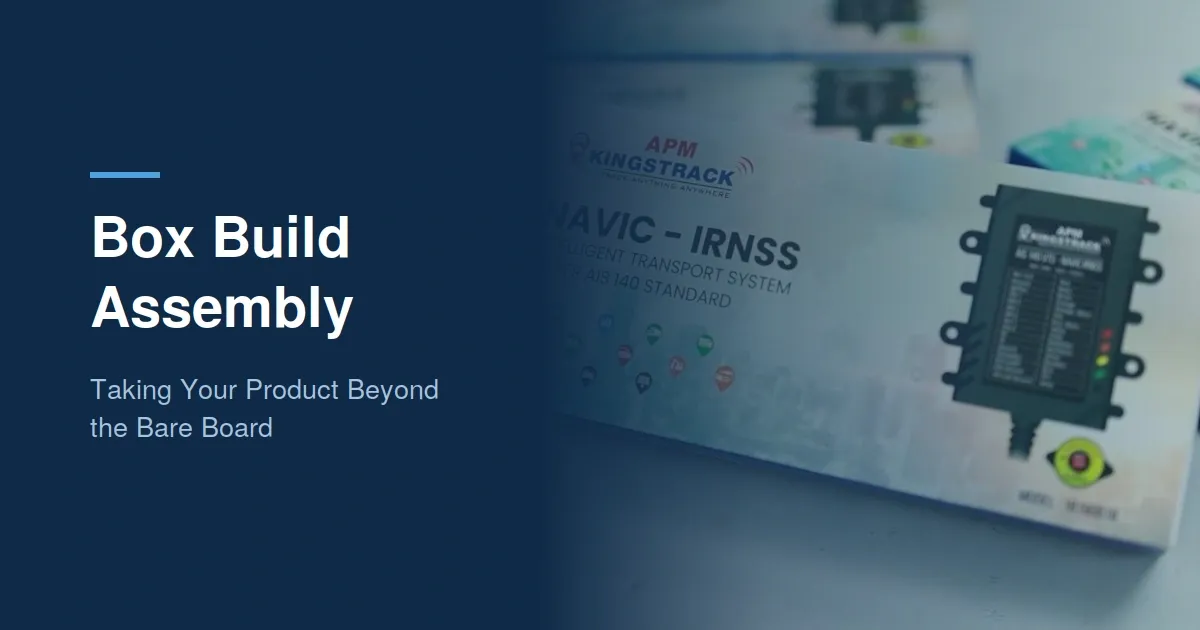
A fully tested PCB is a big milestone, but it is not a product yet. It still has to go into an enclosure, get connected to cables, displays, switches and power supplies, run its firmware, pass a final test and be packed for shipping. All of that is box build assembly, sometimes called system integration.
Many OEMs split this work: one supplier builds the boards, another the harnesses, and the final assembly happens in-house. That works, but every hand-off adds lead time, logistics and room for things to go wrong.
What box build usually includes
- Mechanical assembly: mounting boards in metal or plastic enclosures, fitting brackets, heatsinks, gaskets, fans, displays and front panels.
- Cables and harnesses: wiring between boards, connectors and panel components, built to drawing and tested for continuity.
- Power components: power supplies, transformers, fuses and switches.
- Firmware and configuration: programming microcontrollers and memory, setting serial numbers or calibration values.
- Final testing: a functional test of the complete unit, often with burn-in or a hi-pot (dielectric strength) test for mains-powered products.
- Labelling and packing: rating labels, serial numbers, manuals, accessories and the retail or industrial packaging.
Why hand it to your EMS partner?
One accountable supplier. If a unit fails final test, there is no argument between a board supplier and an assembler about whose fault it is.
Shorter lead times. Boards go straight from SMT and testing into final assembly, instead of being shipped, received, inspected and stored by another supplier.
Consistent quality. The same quality system, ESD controls and traceability cover the board and the finished unit.
Lower overheads. You avoid running your own assembly line, test stations and stores for a product you may only build a few hundred times a year.
Simpler supply chain. One purchase order and one delivery of finished goods, instead of managing parts flowing between several suppliers.
When to keep it in-house
Box build is not always the right call. Keep final assembly in-house if the product involves proprietary calibration you cannot share, very large or heavy mechanics, or final configuration done per customer order. A middle path is common: the EMS partner delivers tested sub-assemblies, and your team does the final step.
What your partner needs from you
Item | Why |
|---|---|
Product BOM (mechanical and electrical) | So every part can be sourced and kitted |
Drawings or a golden sample | So assembly is unambiguous |
Harness drawings | Lengths, connectors, wire gauge, labelling |
Firmware and programming method | To load and verify it on every unit |
Test procedure and pass/fail limits | So final test means the same thing to both sides |
Labelling and packing specification | So units ship ready for your customer |
Box build at Polyfit
Polyfit's EMS division takes products from component sourcing through PCB assembly, testing and conformal coating to box build and packing. Discuss your product with us.
From precision components to custom manufacturing, Polyfit delivers solutions tailored to your application and specifications.
Request a quote