How to read a hydraulic hose spec table
Dash size, DN, working vs burst pressure and bend radius, decoded.
Dash size, DN, working vs burst pressure and bend radius, decoded.
When you first look at a hydraulic hose specification table, it can seem like a collection of numbers with very little context.
You may see columns for dash size, DN, hose ID, hose OD, working pressure, burst pressure, minimum bend radius, temperature and weight. The problem is that these numbers are only useful when you know what each one actually means.
For example, a hose marked -8 does not mean the hose has an 8 mm inside diameter. Similarly, a hose rated at 3,000 psi working pressure should not be selected simply because the hydraulic system normally operates at 2,500 psi.
The same basic approach applies when comparing different hose constructions, including rubber hose and thermoplastic hose. Composite hoses can also have specification tables, but their selection criteria can be different depending on the fluid, temperature and application.
This guide explains how to read a hydraulic hose specification table and, more importantly, which numbers you should pay attention to before selecting a hose or hose assembly.
What information is normally shown in a hydraulic hose specification table?
A typical hydraulic hose specification table may contain:
SpecificationWhat it tells you
Dash Size - Nominal hose size used in the industry
DN - Nominal diameter designation
Hose ID - Actual internal diameter
Hose OD - Outside diameter of the hose
Working Pressure - Maximum recommended operating pressure
Burst Pressure - Pressure at which the hose is tested to failure
Minimum Bend Radius - Smallest recommended bending radius
Temperature Range - Recommended operating temperature range
Weight - Hose weight per unit length
Standard - Standard or specification to which the hose is manufactured
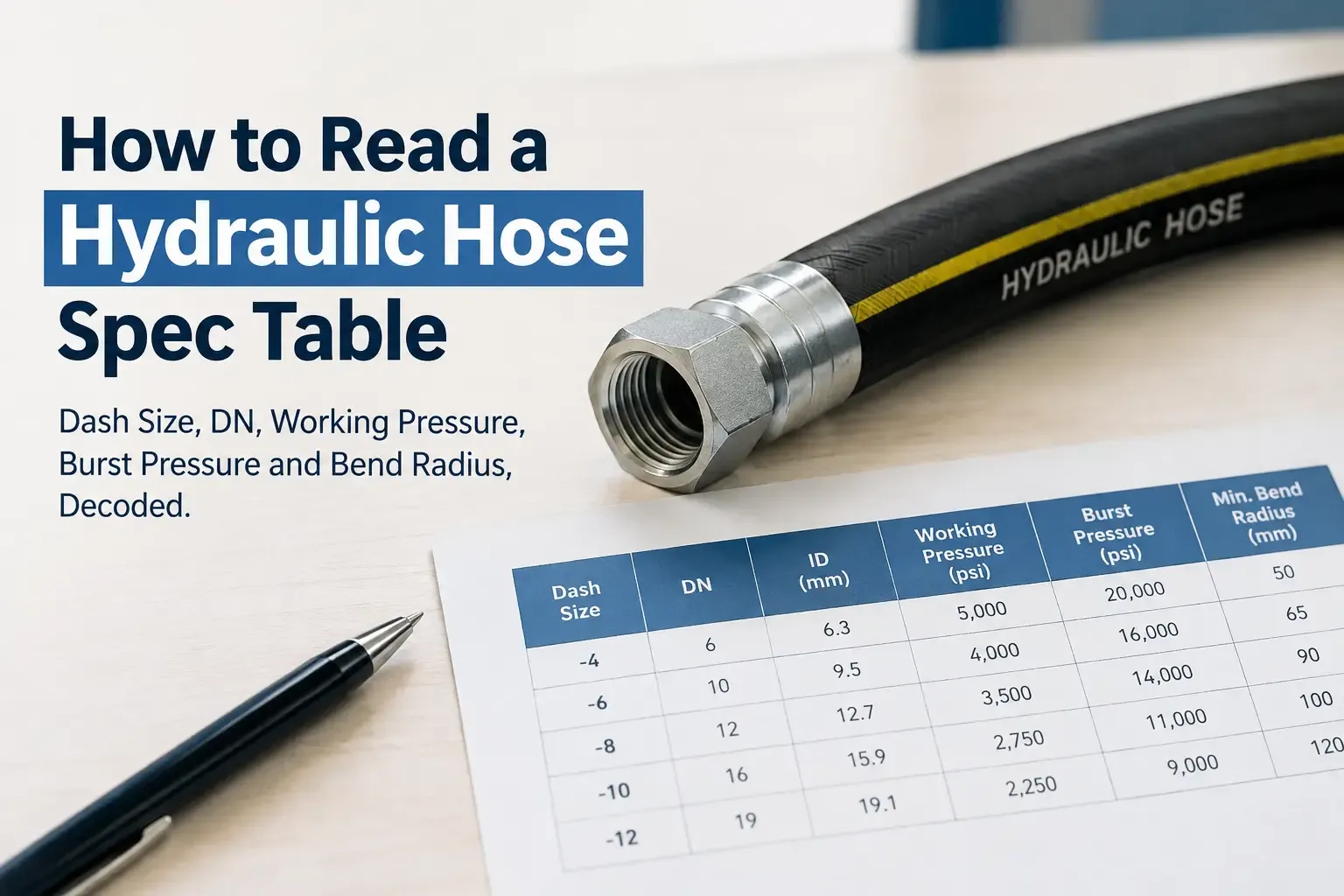
A typical manufacturer's table might look something like this:
Hose Size | DN | ID | Working Pressure | Burst Pressure | Min. Bend Radius |
|---|---|---|---|---|---|
-4 | 6 | 6.3 mm | 5,000 psi | 20,000 psi | 50 mm |
-6 | 10 | 9.5 mm | 4,000 psi | 16,000 psi | 65 mm |
-8 | 12 | 12.7 mm | 3,500 psi | 14,000 psi | 90 mm |
-10 | 16 | 15.9 mm | 2,750 psi | 11,000 psi | 100 mm |
-12 | 19 | 19.1 mm | 2,250 psi | 9,000 psi | 120 mm |
These figures are illustrative of how a specification table is read. Actual ratings vary by hose construction and manufacturer.
Parker and Gates, for example, publish hose tables showing size, ID, OD, working pressure, burst pressure and minimum bend radius together.
What is dash size in a hydraulic hose?
Dash size is the standard shorthand used to identify the nominal size of a hydraulic hose.
It is normally written as a number preceded by a dash:
- -4
- -6
- -8
- -10
- -12
- -16
The number generally corresponds to the hose's nominal inside diameter in sixteenths of an inch.
For example:
-4 hose
A -4 hose has a nominal ID of approximately:
4/16 inch = 1/4 inch
-8 hose
An -8 hose has a nominal ID of approximately:
8/16 inch = 1/2 inch
-16 hose
A -16 hose has a nominal ID of approximately:
16/16 inch = 1 inch
However, dash size is a nominal identification, not a guarantee of the exact measured inside diameter.
The actual ID should always be checked in the manufacturer's specification table.
Common hydraulic hose sizes
Dash Size | Approx. Nominal ID |
|---|---|
-4 | 1/4 in |
-5 | 5/16 in |
-6 | 3/8 in |
-8 | 1/2 in |
-10 | 5/8 in |
-12 | 3/4 in |
-16 | 1 in |
-20 | 1-1/4 in |
-24 | 1-1/2 in |
-32 | 2 in |
Important: Do not assume that every manufacturer uses exactly the same dimensions or pressure rating for a particular dash size. The hose's own specification table is the final reference.
What does DN mean on a hose specification table?
DN means nominal diameter.
It is commonly used in metric and international hose specifications.
For example:
- DN 6 ≈ 6 mm nominal size
- DN 10 ≈ 10 mm nominal size
- DN 12 ≈ 12 mm nominal size
- DN 16 ≈ 16 mm nominal size
- DN 19 ≈ 19 mm nominal size
- DN 25 ≈ 25 mm nominal size
DN and dash size are two different ways of identifying hose size.
A specification table may therefore show:
Size: -8 | DN 12 | ID: 12.7 mm | 1/2 inch
This is not four different hose sizes. They are different designations describing essentially the same nominal size.
Is DN the exact inside diameter?
No.
DN is a nominal designation. It should not be treated as a measurement of the hose's actual internal diameter.
If flow calculation, pressure drop or connection selection is important, use the manufacturer's stated hose ID, rather than trying to calculate it from DN.
What is hose ID and why does it matter?
ID means inside diameter.
It is one of the most important numbers in a hydraulic hose specification because it affects how easily hydraulic fluid can flow through the hose.
A hose that is too small can create:
- Higher pressure drop
- Increased fluid velocity
- Greater heat generation
- Reduced system efficiency
- Potential flow restrictions
A hose that is unnecessarily large, on the other hand, may increase cost, weight and installation space.
For this reason, hose size should be selected based on required flow and acceptable pressure drop, not pressure rating alone.
The hose ID is also important when matching the hose to fittings and adapters.
What is hose OD?
OD means outside diameter.
The outside diameter matters when the hose has to pass through:
- Clamps
- Bulkheads
- Protective sleeves
- Cable or hose carriers
- Machine openings
- Routing channels
It is also useful when checking whether a replacement hose will physically fit in an existing installation.
Two hoses can have the same nominal ID but different outside diameters because their construction and reinforcement are different.
For example, a reinforced rubber hose and a thermoplastic hose may have different OD dimensions even when they are intended for similar applications.
Working pressure vs burst pressure: what is the difference?
This is one of the most important parts of any hydraulic hose specification table.
Working pressure
Working pressure is the maximum pressure the hose is designed to withstand during normal service under the manufacturer's specified conditions.
If a hose is rated:
Working pressure: 3,000 psi
that is the pressure rating you should use when selecting the hose for a hydraulic system.
It does not mean that operating continuously at 3,000 psi is automatically safe under every condition. Temperature, fluid, hose age, routing, movement, fittings and pressure surges all matter.
Burst pressure
Burst pressure is the pressure at which the hose is expected to fail during a specified test.
It is not the pressure at which the hose should be operated.
This distinction is critical.
If a hose specification says:
- Working pressure: 3,000 psi
- Burst pressure: 12,000 psi
you should not interpret the 12,000 psi figure as available operating capacity.
The burst rating is a test/failure limit, not a recommended operating pressure.
Parker, for example, notes that burst pressure ratings are based on testing and that maximum recommended working pressure is normally based on a defined design factor.
Why is burst pressure much higher than working pressure?
Hydraulic hoses are designed with a safety margin between their normal working pressure and their tested burst pressure.
A commonly encountered relationship is a 4:1 burst-to-working-pressure ratio, although the actual ratio depends on the applicable hose standard and product specification.
For example:
3,000 psi working pressure → 12,000 psi minimum burst pressure
does not mean the hose is intended to handle 12,000 psi.
It means the hose has been designed and tested with a substantial margin above its specified working pressure.
Different hose standards and product families can have different requirements, so the manufacturer's published rating should always take precedence.
What is minimum bend radius?
The minimum bend radius tells you how tightly the hose can be bent without going below the manufacturer's recommended limit.
It is usually expressed in millimetres or inches.
For example:
Minimum bend radius: 100 mm
means the hose should not be installed with a bend radius smaller than 100 mm under the conditions specified for that hose.
Bend radius is not the same as bend diameter
This causes quite a bit of confusion.
If the minimum bend radius is 100 mm, the corresponding bend diameter is approximately:
200 mm
So you should not interpret a 100 mm minimum bend radius as allowing the hose to bend around a 100 mm diameter circle.
Why is bend radius important?
Forcing a hose into a tighter bend than recommended can place excessive stress on the reinforcement and hose tube.
Over time, this can contribute to:
- Premature hose failure
- Kinking
- Reinforcement damage
- Reduced service life
- Fitting or coupling stress
- Flow restriction
The minimum bend radius is therefore an installation requirement, not simply a dimension included for reference.
Parker specifically notes that its published minimum bend radii apply at the stated working pressures and service temperatures, and that continuous flexing or exceeding the recommended radius can shorten hose life.
How rubber hose and thermoplastic hose specifications differ
Not every hose should be read or selected in exactly the same way.
Rubber hose
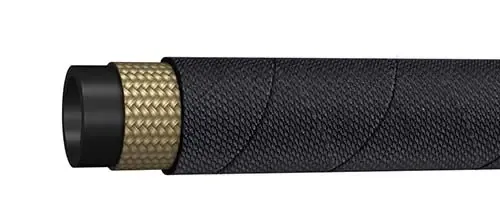
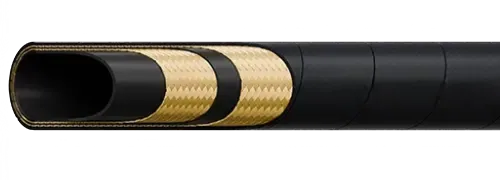
Hydraulic rubber hoses are commonly reinforced with textile, wire braid or wire spiral constructions.
Their specification tables commonly include:
- Dash size
- DN
- ID and OD
- Working pressure
- Burst pressure
- Minimum bend radius
- Temperature range
- Applicable standards
The reinforcement construction has a major influence on the pressure capability and flexibility of the hose.
Thermoplastic hose
Thermoplastic hydraulic hoses use a thermoplastic inner tube and are available with different reinforcement constructions.
They are often used where factors such as:
- Compact routing
- Low weight
- Flexibility
- Abrasion resistance
- Electrical characteristics
- High-pressure service
are important.
The same basic numbers still matter — ID, working pressure, burst pressure and bend radius — but the ratings are specific to the particular hose construction.
A thermoplastic hose should therefore never be substituted for a rubber hose based only on the fact that both have the same dash size.
What about composite hose?
Composite hose is a different category and should not automatically be treated as another type of hydraulic hose.
Composite hoses are constructed from multiple layers and are commonly used for transferring fluids where flexibility, chemical resistance, temperature and handling characteristics are important.
Depending on the product, they may be used for applications such as:
- Chemicals
- Fuels
- Oils
- Solvents
- Petroleum products
- Loading and unloading systems
When reading a composite hose specification, look beyond pressure alone.
You should also check:
- Fluid compatibility
- Temperature range
- Electrical properties
- Construction
- Vacuum capability
- Bend radius
- Cover material
- Applicable standards
- End connections
The correct hose is determined by the complete application, not simply by matching a pressure number.
How to read a hydraulic hose spec table: a practical example
Imagine you are looking at this row:
Size | DN | ID | Working Pressure | Burst Pressure | Bend Radius |
|---|---|---|---|---|---|
-8 | 12 | 12.7 mm | 3,500 psi | 14,000 psi | 90 mm |
Here is what it means.
1. Size: -8
The hose has a nominal dash size of -8, corresponding approximately to a 1/2-inch nominal bore.
2. DN: 12
The metric nominal designation is DN 12.
3. ID: 12.7 mm
The actual specified inside diameter is approximately 12.7 mm.
This is the number to pay attention to when considering flow and pressure drop.
4. Working pressure: 3,500 psi
The hose is rated for a maximum working pressure of 3,500 psi under the manufacturer's specified conditions.
5. Burst pressure: 14,000 psi
The hose has a specified minimum burst rating of 14,000 psi.
This is not the operating pressure.
6. Minimum bend radius: 90 mm
The hose should not be installed with a bend radius below 90 mm under the applicable rating conditions.
That one row already tells you a lot about how the hose can be used.
What should you check before selecting a hydraulic hose?
Don't start with the hose catalogue. Start with the application.
A good hose selection process should consider:
1. Required flow
Determine the required flow rate first.
This helps establish the appropriate hose ID and helps control fluid velocity and pressure drop.
2. Maximum operating pressure
Look at the highest pressure the system can actually experience, including relevant pressure spikes or transient conditions — not just the normal gauge reading.
The hose's working pressure must be suitable for the application.
3. Fluid
Check whether the hose is compatible with the hydraulic fluid or other medium being carried.
Fluid compatibility is particularly important when selecting rubber, thermoplastic or composite hose constructions.
4. Temperature
Check both the fluid temperature and the surrounding environmental temperature.
A hose's pressure capability and service life can be affected by temperature. ISO 18752:2025, for example, defines different temperature ranges for specified hydraulic hose types and fluids.
5. Bend radius and routing
Look at the actual installation.
If the hose needs to make a tight turn, the published minimum bend radius becomes a critical selection parameter.
6. Movement
Is the hose:
- Stationary?
- Flexing continuously?
- Moving with a machine?
- Subject to vibration?
A hose suitable for a stationary line may not be the right choice for continuous flexing.
7. Fittings and assembly
Don't select the hose in isolation.
The completed hose assembly includes the hose, fittings/couplings and the assembly method.
The assembly's pressure rating is governed by the component with the lowest applicable rating. ISO 18752:2025 specifically notes that the maximum working pressure of a hose assembly is governed by the lowest maximum working pressure of its components.
A simple way to remember hydraulic hose specifications
When you open a hose catalogue, read the table in this order:
Size → ID → Flow → Working Pressure → Temperature → Bend Radius → Fluid Compatibility → Fittings
Don't start by looking for the biggest pressure number.
A hose that has a very high pressure rating but the wrong bore, wrong temperature rating, wrong fluid compatibility or insufficient bend radius is still the wrong hose.
Common mistakes when reading a hose specification table
Mistake 1: Treating dash size as the exact ID
A -8 hose does not mean the measured ID will always be exactly 8 mm.
Dash size is a nominal designation.
Mistake 2: Using burst pressure as operating pressure
This is one of the most serious mistakes.
Working pressure is the number used for normal application selection. Burst pressure is not.
Mistake 3: Ignoring bend radius
A hose may have the right pressure rating but still be unsuitable for the installation if it cannot be routed within the required space.
Mistake 4: Selecting by pressure alone
Pressure is only one part of hose selection.
Fluid, temperature, flow, movement, environment, bend radius and fittings also need to be considered.
Mistake 5: Assuming hoses with the same size are interchangeable
Two -12 hoses can have different pressure ratings, dimensions, reinforcement, temperature ratings and bend radii.
Always check the manufacturer's specification.
From precision components to custom manufacturing, Polyfit delivers solutions tailored to your application and specifications.
Request a quote