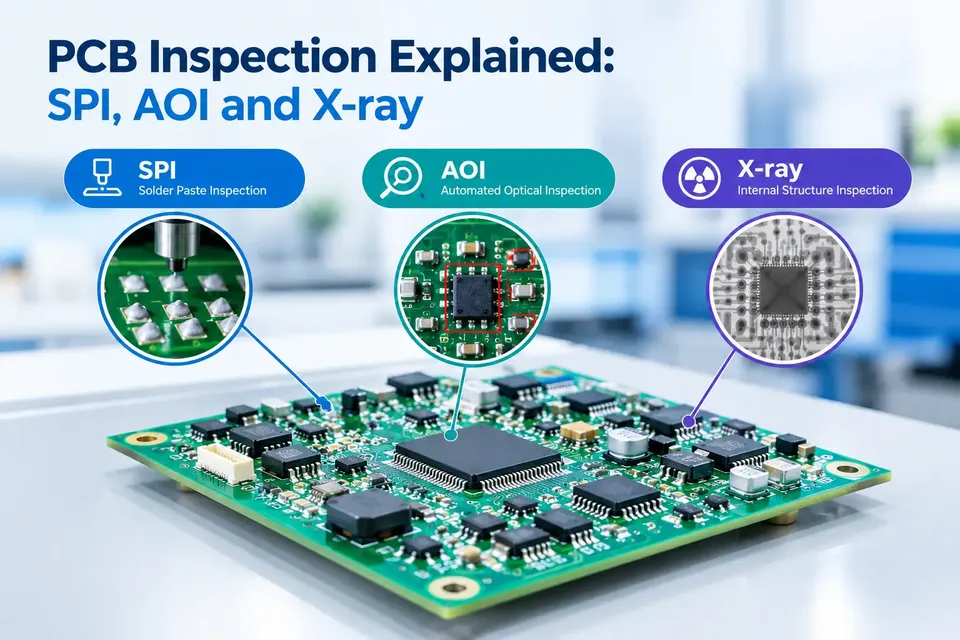
Quality Control in Electronics Manufacturing: IPC, ESD, MSL and Cleanrooms
Reliable boards come from controls that run through every stage of manufacturing, from parts storage to packing. These are the ones that matter most.
"Quality" on an EMS brochure usually means a certificate on the wall. On the factory floor it means a set of controls that run through every stage, from how components are stored to how finished boards are packed. These are the ones that make the biggest difference to whether your boards work in the field.
IPC-A-610: a shared definition of "good"
IPC-A-610, Acceptability of Electronic Assemblies, is the reference most of the industry uses to judge finished boards. It describes, with photographs and drawings, what an acceptable solder joint, component placement or cleanliness level looks like.
It defines three classes:
Class | Typical products | What it means |
|---|---|---|
Class 1 | General consumer electronics | The product works; cosmetic imperfections allowed |
Class 2 | Industrial controls, communications, instrumentation | Extended life and reliable service; some cosmetic tolerance |
Class 3 | Medical, aerospace, critical systems | High reliability, uninterrupted operation, strictest criteria |
Agreeing the class at the quote stage avoids arguments later. Inspectors trained to IPC-A-610 judge joints the same way your own quality team would.
ESD control: protecting parts you cannot see failing
Electrostatic discharge (ESD) can damage semiconductors at voltages far below what a person can feel. The worst part is that the damage is often latent: the board passes test and fails months later in the field.
ESD control means:
- grounded workstations, mats and wrist straps;
- ESD-safe flooring, footwear and clothing in the production area;
- ESD-safe bags, trays and packaging for every board;
- regular checks that all of it is still working;
- operators trained in why it matters, not just told to wear a strap.
MSL handling: moisture is a real threat
Many plastic IC packages absorb moisture from the air. In the reflow oven that moisture turns to steam and can crack the package or delaminate it from the die, a defect sometimes called popcorning.
Each component carries a moisture sensitivity level (MSL), from MSL 1 (not sensitive) up to MSL 6, defined by the IPC/JEDEC J-STD-020 standard. Handling rules under J-STD-033 set how long a part can sit outside its sealed bag (its floor life) before it must be baked. Good MSL control means tracking open time for every reel and baking parts when needed, every time.
Cleanrooms and controlled environments
Dust and particles can interfere with fine-pitch printing and soldering and contaminate sensitive assemblies. A cleanroom keeps airborne particles below a defined limit and also controls temperature and humidity, which affect solder paste behaviour and ESD.
Cleanrooms are graded under ISO 14644-1. An ISO 7 room is the equivalent of the older Class 10,000 (Class 10K) grade: no more than 10,000 particles of 0.5 µm or larger per cubic foot of air.
Process control on the line
Inspection catches problems; process control stops them. On an SMT line that includes:
- Solder paste management: controlled thawing, viscosity checks and use within working life;
- Stencil inspection and cleaning to keep apertures clear;
- SPI and AOI data reviewed for trends, not just pass or fail;
- Reflow profiles measured on the actual product.
Traceability
When something does go wrong, you want to know which boards are affected. Traceability links each board or batch to the component lots, paste, process settings and inspection results that went into it. It is what turns a field failure from a recall of everything into a targeted fix.
Quality at Polyfit's EMS division
Polyfit builds in a Class 10K (ISO 7) cleanroom with controlled temperature, humidity and ESD protection, to IPC-A-610, with staff trained in IPC and ESD practices. Moisture-sensitive parts are handled under MSL control, and our SMT lab manages paste with a thawing machine, viscometer, stencil inspection and baking oven. Inspection covers SPI and AOI, followed by functional testing. Ask us about our quality process.
From precision components to custom manufacturing, Polyfit delivers solutions tailored to your application and specifications.
Request a quote