Types of Hydraulic Hose Fittings: How Each One Seals, How to Identify It and Which to Use
NPT, BSP, JIC, ORFS, metric, JIS, flanges and quick couplers: how every common hydraulic hose fitting seals, a thread identification chart, and how to pick the right end for your machine.
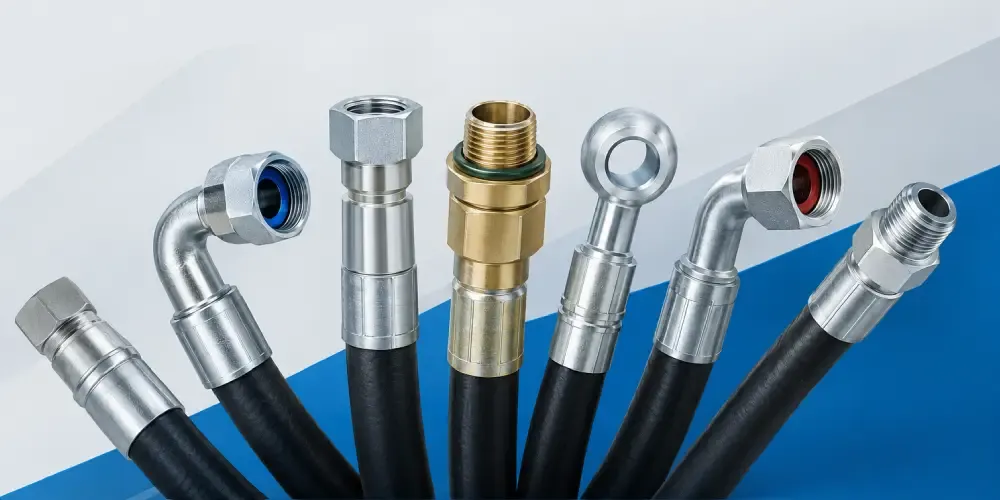
A hydraulic hose fitting has one job: hold oil at pressure without leaking, for years, while the machine shakes, heats up and cools down. Most fitting failures we see in our hose assembly shop do not come from bad parts. They come from the wrong end being chosen, or two ends that look alike being forced together.
This guide sorts the common fittings the way an engineer would: first by how they seal, then by thread standard, then by how they attach to the hose. It ends with a five-step method to identify any fitting on your bench, and a short checklist for choosing one.
Hydraulic fitting types at a glance
Every fitting below is in use somewhere in the world today. Which one you meet depends mostly on where the machine was designed.
Fitting type | How it seals | Thread / seat | Standard | Where you find it | Good for high pressure? |
|---|---|---|---|---|---|
NPT / NPTF | Tapered thread | 60° thread, tapered 1 in 16 | ASME B1.20.1 / B1.20.3 | Older US equipment, ports, plugs | Limited |
BSPT | Tapered thread | 55° thread, tapered | ISO 7-1 | UK, Europe, Asia pipework | Limited |
BSPP | 60° cone, or bonded seal at the port | 55° thread, parallel | ISO 228-1, ISO 1179 | UK, Europe, India, Australia | Medium |
JIC 37° flare | Metal-to-metal cone | 37° flare, UNF thread | SAE J514, ISO 8434-2 | US and global mobile equipment | Medium–high |
SAE 45° flare | Metal-to-metal cone | 45° flare | SAE J512 | Fuel, refrigeration, low-pressure lines | No |
ORFS | O-ring in a flat face | Flat face, UN thread | SAE J1453, ISO 8434-3 | Construction, mining, agriculture | Yes |
SAE O-ring boss (ORB) | O-ring on a straight thread | UNF/UN thread | SAE J1926, ISO 11926 | Pump, valve and cylinder ports | Yes |
Metric DIN 24° cone | Cutting ring, or cone with O-ring | Metric fine thread | DIN 2353, ISO 8434-1 | European machines | Yes (S series) |
Metric ISO 6149 port | O-ring on a straight thread | Metric thread | ISO 6149 | Modern European ports | Yes |
JIS | 60° cone (30° seat) | JIS parallel or metric | JIS B 0202 / B 0207 | Japanese excavators and machinery | Medium |
SAE Code 61 / 62 flange | O-ring in a flange face | Four bolts, no thread | SAE J518, ISO 6162-1 / -2 | Large hoses, pump suction and pressure | Yes (Code 62) |
Quick-release coupling | Valve and seal | Various bodies | ISO 7241, ISO 16028 | Attachments, test points, tractors | Depends on type |
The three ways a hydraulic fitting seals
Before the alphabet soup of standards, it helps to know that every fitting seals in one of three ways. Get this right and most identification problems become simple.
1. Thread seals (tapered threads)
NPT, NPTF and BSPT threads are tapered. As you tighten them, the male and female threads wedge together and the metal deforms slightly to close the gap. They usually need a sealant.
Tapered threads are cheap and compact, but they have weaknesses in hydraulics. Every reassembly deforms the threads further, overtightening can crack a cast port, and vibration loosens them. That is why modern hydraulic designs avoid them for anything above moderate pressure.
2. Metal-to-metal seals (mated angles)
JIC 37°, SAE 45°, BSPP 60° cone, JIS and metric DIN 24° fittings seal where two machined cones meet. The thread only pulls the cones together; it does not seal anything.
These joints are robust and can be remade several times. Their weak point is torque: too little and they weep, too much and the cone cracks or the flare thins. Fitters often use the "flats from wrench resistance" method (tighten by hand, then turn a set number of hex flats) rather than relying on a torque wrench alone.
3. O-ring seals
ORFS, SAE O-ring boss, ISO 6149, DIN fittings with an O-ring and SAE flanges all rely on an elastomer O-ring squeezed into a groove. The metal parts only hold the O-ring in place.
O-ring joints tolerate vibration and small misalignments far better than metal-to-metal ones, and they can be made leak-free at high pressure. The trade-off is that the O-ring must suit the fluid and temperature, and it must be replaced when the joint is remade.
The common hydraulic hose fitting types in detail
NPT and NPTF (National Pipe Taper)
The American tapered pipe thread has a 60° thread angle and tapers at 1 in 16 on the diameter. NPT relies on sealant to fill a small spiral gap at the thread crests. NPTF, the "dryseal" version, is machined so the crests and roots crush together and can seal without sealant.
You will find NPT on older North American machines, on many pump and valve ports, and on plugs and gauges. It works, but it is the first thing most hydraulic engineers replace when a system keeps leaking.
BSP: BSPT and BSPP (British Standard Pipe)
BSP threads use the 55° Whitworth thread form. They come in two versions that are often confused:
- BSPT (tapered, ISO 7-1) seals on the threads like NPT.
- BSPP (parallel, ISO 228-1) does not seal on the threads at all. On hose ends it seals with a 60° cone (a 30° half-angle) between the male and the swivel female. At a port, it seals with a bonded washer or a soft seal under the fitting's face (ISO 1179).
BSPP is the default hose end across the UK, Europe, India, Australia and much of Asia. If you work on equipment built in these regions, this is the fitting you will handle most.
JIC 37° flare
JIC fittings have a 37° flare seat and a straight UNF thread. They began as tube fittings for aerospace and military use, and their wide availability made them a standard hose end for mobile and industrial machines worldwide.
A JIC joint is easy to make and easy to remake, which is its biggest strength. Its weakness is that it is metal-to-metal. On machines with heavy vibration or pressure spikes it can loosen over time, which is why many manufacturers moved to ORFS.
SAE 45° flare
SAE 45° flare fittings look like JIC but have a 45° seat. They are mostly brass and designed for low pressures: fuel lines, refrigeration and air conditioning, and instrument lines. They should never be used in a working hydraulic circuit, and they will not seal against a 37° JIC seat even where the thread matches.
ORFS (O-ring face seal)
An ORFS male has a flat face with an O-ring in a groove. The female swivel has a flat face that presses onto it. Because the seal is an O-ring rather than metal-to-metal, ORFS stays leak-free under heavy vibration and high pressure, typically up to about 6,000 psi (414 bar) in smaller sizes.
ORFS (SAE J1453 / ISO 8434-3) is now common on construction, mining, forestry and agricultural machines. If a machine has a history of weeping JIC joints, converting to ORFS is often the permanent fix.
SAE O-ring boss (ORB)
ORB is a port fitting, not a hose-to-hose joint. The male has a straight UNF/UN thread and an O-ring that sits in a chamfer at the mouth of the port. It is the most common port on North American pumps, valves and cylinders, and is often found on the opposite end of an adapter to a JIC or ORFS hose connection.
Metric DIN 24° cone
The German DIN system (DIN 2353, now ISO 8434-1) uses a 24° internal cone and metric fine threads. It comes in two pressure series: L (light) and S (heavy). The same tube size has a different thread in each series, so always confirm which one you have.
On tube connections the seal is a cutting ring that bites into the tube. On hose ends the common types are DKOL and DKOS: a 24° cone with an O-ring on the nose, which adds the vibration resistance of an O-ring to the DIN cone. You will find these on most European tractors, cranes and industrial machinery.
Metric ISO 6149 ports
ISO 6149 is the metric equivalent of the SAE O-ring boss: a straight metric thread with an O-ring at the port mouth. Ports made to this standard usually carry a small raised ring or marking so a fitter can tell them apart from older metric ports at a glance.
JIS (Japanese Industrial Standard)
Japanese machines use JIS fittings, usually with a 30° seat (60° included cone). The threads are either JIS parallel pipe threads (JIS B 0202, dimensionally close to BSPP) or metric fine threads (JIS B 0207). Some Japanese excavator brands use their own variations.
The trap with JIS is that a JIS fitting can thread onto a BSPP or metric part and still not seal, because the seat angles differ. Always check the seat angle as well as the thread.
SAE Code 61 and Code 62 flanges
Large hoses (typically 3/4 inch and up) are hard to tighten with a thread, so they connect with a four-bolt split flange instead. The flange clamps an O-ring into the face of the port.
- Code 61 (ISO 6162-1) is the standard-pressure series, roughly 3,000 to 5,000 psi depending on size.
- Code 62 (ISO 6162-2) is the high-pressure series, rated around 6,000 psi, with a thicker flange head and larger bolts.
They look similar but are not interchangeable, so measure the bolt spacing and flange diameter before ordering. Heavier 9,000 psi flange styles also exist for very high-pressure equipment.
Quick-release couplings
Quick couplings let you connect and disconnect a line without tools, with valves on both halves that close as they part. The three families you will meet most:
- ISO 7241 Series A and B: poppet or ball-valve couplers, common on tractors and general hydraulics.
- ISO 16028 flat face: no spill when disconnecting and very little air drawn in when connecting. The usual choice for attachments on skid steers and excavators.
- Screw-to-connect couplings: thread together, used where pressure is high or pulsing, such as hydraulic tools and breakers.
Quick couplings add pressure drop and are only as clean as their caps. Keep them covered when they are not connected.
How fittings attach to the hose
The connection type is only half of a hose fitting. The other half is how it grips the hose.
Attachment | How it works | Typical use |
|---|---|---|
Crimped (permanent) | A ferrule is compressed onto the hose by a crimping machine to an exact diameter | Almost all high-pressure hose assemblies |
One-piece crimp | Insert and ferrule are a single part, so there is nothing to misalign | Production assemblies, braided hose |
Two-piece crimp | Separate ferrule and insert, chosen to suit the hose | Spiral hose and special combinations |
Reusable (field-attachable) | The fitting screws onto the hose with hand tools, no crimper needed | Field repairs, remote sites, lower pressures |
Push-on | Barbed insert pushed into special low-pressure hose, no clamp | Air, lubrication and return lines |
A crimped fitting is only as good as its crimp specification. The ferrule, insert and crimp diameter must be matched to the exact hose. Mixing a fitting from one manufacturer with hose from another without a tested crimp specification is one of the most common causes of hose blow-off.
Shapes and configurations
Each connection type is made in a range of shapes so the hose can be routed without kinks:
- Straight: the default, the strongest and the cheapest.
- 45° and 90° elbows: to clear obstructions and avoid tight hose bends. Elbows come as compact forged bodies or bent-tube "swept" versions with a longer reach.
- Swivel females: let the hose be tightened without twisting it, which is critical for hose life.
- Banjo fittings: a hollow bolt through a ring, for tight spaces on engines and pumps.
- Tees, crosses and bulkhead fittings: to branch a line or pass it through a panel.
Use an elbow rather than forcing a hose into a tight bend. A hose bent tighter than its minimum bend radius wears out far faster.
Materials and plating
- Carbon steel with zinc plating: the standard for most hydraulic fittings. Modern trivalent (Cr3+) passivation replaces the older hexavalent chrome finish for environmental reasons.
- Stainless steel (usually 316): for corrosive, marine, offshore, food and chemical applications. More expensive, and harder to crimp, so it needs matched ferrules.
- Brass: for low-pressure lines, fuel and instrumentation.
How to identify a hydraulic fitting in 5 steps
You need a caliper, a thread pitch gauge (inch and metric) and a seat angle gauge.
- Look at the sealing method. Is there an O-ring on a flat face (ORFS), an O-ring on the thread (ORB, ISO 6149), a cone or flare (JIC, BSPP, DIN, JIS), or just tapered threads (NPT, BSPT)?
- Tapered or parallel? Lay a straight edge along the thread or measure the diameter at the first and last full thread. A difference means a tapered thread.
- Measure the thread diameter. Measure the outside of a male thread or the inside of a female thread with a caliper.
- Measure the pitch. Use the gauge to find threads per inch (inch threads) or the pitch in millimetres (metric).
- Check the seat angle. Place the seat gauge on the cone or flare: 24° (DIN), 30° seat / 60° cone (BSPP, JIS), 37° (JIC), 45° (SAE flare), or flat (ORFS).
Then compare your readings with a chart like the one below.
Thread identification chart (common sizes)
Diameters are nominal male thread sizes. Worn or measured threads read slightly smaller.
Type | Nominal size | Thread | Male thread OD (approx.) |
|---|---|---|---|
BSP (BSPP / BSPT) | 1/4 in | 19 TPI | 13.2 mm |
BSP (BSPP / BSPT) | 3/8 in | 19 TPI | 16.7 mm |
BSP (BSPP / BSPT) | 1/2 in | 14 TPI | 21.0 mm |
BSP (BSPP / BSPT) | 3/4 in | 14 TPI | 26.4 mm |
NPT / NPTF | 1/4 in | 18 TPI | 13.7 mm |
NPT / NPTF | 3/8 in | 18 TPI | 17.1 mm |
NPT / NPTF | 1/2 in | 14 TPI | 21.3 mm |
NPT / NPTF | 3/4 in | 14 TPI | 26.7 mm |
JIC 37° / SAE ORB | -4 | 7/16-20 UNF | 11.1 mm |
JIC 37° / SAE ORB | -6 | 9/16-18 UNF | 14.3 mm |
JIC 37° / SAE ORB | -8 | 3/4-16 UNF | 19.1 mm |
JIC 37° / SAE ORB | -12 | 1 1/16-12 UN | 27.0 mm |
ORFS | -4 | 9/16-18 UNF | 14.3 mm |
ORFS | -6 | 11/16-16 UN | 17.5 mm |
ORFS | -8 | 13/16-16 UN | 20.6 mm |
ORFS | -12 | 1 3/16-12 UN | 30.2 mm |
Metric DIN 24° | 8L / 6S | M14 x 1.5 | 14 mm |
Metric DIN 24° | 12L / 10S | M18 x 1.5 | 18 mm |
Metric DIN 24° | 15L / 14S | M22 x 1.5 | 22 mm |
Notice the near misses. A 1/2 inch BSP and a 1/2 inch NPT are both 14 TPI and less than half a millimetre apart in diameter, so they will start to thread together and still leak. A -4 ORFS and a -6 JIC share the 9/16-18 thread but have completely different seals. This is exactly why step 5, the seat check, matters.
How to choose the right hydraulic fitting
Hose engineers use the STAMPED checklist: Size, Temperature, Application, Media, Pressure, Ends and Delivery. For the ends specifically:
- Match what the machine already uses. The port decides the fitting. Use adapters sparingly, because every extra joint is another possible leak.
- Rate the whole assembly. Its working pressure is the lowest of the hose, the fitting and the adapters, so check all three.
- Choose O-ring seals for vibration and high pressure. ORFS, ORB, ISO 6149, DIN with O-ring, or Code 62 flanges.
- Match the seal material to the fluid and temperature. Nitrile (NBR) for mineral oils; FKM (Viton) for higher temperatures and some fire-resistant fluids.
- Plan for maintenance. Swivel ends, sensible orientation and enough wrench clearance save hours on every service.
For the hose side of the decision, see our guide on how to select a hydraulic hose.
Mistakes that cause most fitting leaks
- Mixing thread standards. Especially NPT with BSPT, and JIS with BSPP. If it feels tight early, stop and check.
- Sealing tape on non-tapered fittings. Tape does nothing on a cone or O-ring seal, and loose shreds end up in valves and filters.
- Over-tightening flare fittings. A crushed 37° flare leaks more, not less. Use the flats method or the manufacturer's torque.
- Reusing O-rings. A flattened or nicked O-ring will not seal again. Replace it every time the joint is opened.
- Twisting the hose during assembly. A twist of just a few degrees can cut hose life sharply. Hold the hose and turn only the swivel nut.
- Unmatched crimp components. Hose, ferrule and insert must be a tested combination, crimped to the specified diameter.
Hydraulic fittings and hose assemblies from Polyfit
Polyfit has been manufacturing hydraulic fittings in Chennai since 1978. Our hydraulic fittings range covers ferrules; NPT, BSP and JIC fittings; metric light and heavy series fittings; ORFS fittings; SAE flanges in 3,000, 6,000 and 9,000 psi ratings; and one-piece fittings.
We also build complete hydraulic hose assemblies with the fittings matched and crimped to the hose. If you are not sure which end you need, send us a photo or a sample and we will identify it.
From precision components to custom manufacturing, Polyfit delivers solutions tailored to your application and specifications.
Request a quote