Electronics Manufacturing Trends Worth Watching (and What They Mean for You)
Plenty of trend lists are hype. These are the changes actually showing up on assembly lines, and what they mean for companies that buy electronics manufacturing.
Every year brings a new list of "trends reshaping electronics manufacturing", most of them heavy on buzzwords. These are the changes actually showing up on assembly lines, and what each one means if you buy electronics manufacturing.
1. Boards keep getting smaller and denser
Packages keep shrinking: 0201 passives, 0.4 mm pitch BGAs, QFNs and wafer-level parts are now routine. Boards carry more layers, more HDI features, and components on both sides. Flexible and rigid-flex boards are common in wearables and compact devices.
What it means for you: placement accuracy, paste control and inspection matter more than ever. Ask any assembler about the smallest parts and finest pitch they place routinely, and how they inspect them.
2. India is now a serious EMS location
Government incentive schemes, a large domestic market and global buyers diversifying away from single-country supply have brought substantial investment into Indian electronics manufacturing, from smartphones to industrial and automotive electronics, along with a growing local component ecosystem.
What it means for you: more capable local partners, shorter supply chains for products sold in India, and an alternative or second source for global programmes. Choosing well still matters: see our partner checklist.
3. Smarter factories and data-driven quality
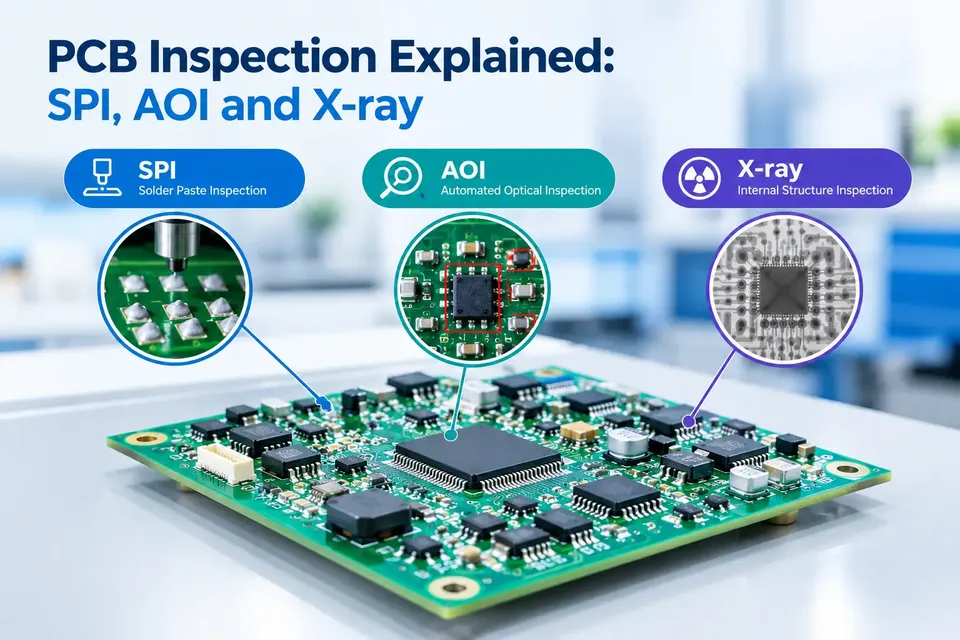
Lines are increasingly connected: solder paste inspection, AOI and test data are collected and analysed rather than just used for pass or fail. AI and machine learning are mostly being used in practical places:
- reducing false calls in optical inspection;
- spotting process drift before it produces defects;
- predicting when machines need maintenance.
What it means for you: ask whether your partner tracks and shares yield and inspection data. It is the clearest sign of real process control.
4. Supply-chain resilience over lowest price
The component shortages of recent years taught everyone a lesson. Buyers now value approved alternates, buffer stock for critical parts, multiple sourcing regions and early warning of risks.
What it means for you: build sourcing resilience into the design and the contract. We cover how in component sourcing.
5. Electrification: EVs, charging and energy
Electric vehicles, charging infrastructure, solar inverters, battery storage and smart grids are growing quickly. They need power electronics that handle high current, heat and harsh environments.
What it means for you: mixed-technology assembly, careful thermal and void control, conformal coating and thorough testing are becoming standard requirements. See PCB assembly for automotive, EV and power electronics.
6. Connected everything: IoT and smart infrastructure
Smart meters, city infrastructure such as lighting, traffic and water monitoring, building automation and asset trackers all need small, low-power, wireless electronics built consistently at volume.
What it means for you: RF-aware assembly and 100% programming and radio testing matter.
7. Sustainability and e-waste
Regulations such as RoHS have already made lead-free assembly the norm. The next steps are designing for longer life and repair, cutting scrap through high first-pass yield, using energy more efficiently in factories, and offering repair and refurbishment instead of replacement.
What it means for you: ask about yields, repair services and the environmental practices of your partner. High first-pass yield cuts both waste and cost.
What has not changed
For all the change, the basics still decide whether a product succeeds: a manufacturable design, reliable parts, a controlled process and honest communication when something goes wrong.
Building what's next
Polyfit's EMS division combines a fully automated SMT line, inspection with SPI and AOI, an ISO 7 cleanroom, and services from component sourcing to box build and repair. Polyfit also has a 400 kWp solar power system. Talk to us about your next product.
From precision components to custom manufacturing, Polyfit delivers solutions tailored to your application and specifications.
Request a quote