Prototype, Low-Volume and High-Volume PCB Assembly: What Changes
The same board is built very differently at 10, 500 and 50,000 pieces. Here is what changes at each stage, and how to plan the move to production.
"How much does it cost to assemble this board?" has no single answer, because the same board is built quite differently at 10 pieces, 500 pieces and 50,000 pieces. Understanding what changes helps you plan budgets, timelines and the move from prototype to production.
Prototypes: proving the design
A prototype run, usually 5 to 50 boards, exists to answer one question: does the design work? Speed matters more than unit cost.
What drives cost here is setup: the stencil, programming the placement machine, loading feeders, and inspecting the first article. On ten boards, that setup can be most of the bill. That is normal, and trying to save on it with a hand-built board can hide problems that only show up on a real line.
Good practice at this stage:
- build on the same kind of line you will use for production, so DFM problems surface now;
- ask for a DFM report alongside the boards (see our DFM checklist);
- plan how you will test, even if it is manual bench testing for now.
Low volume: pilot runs and niche products
Low-volume production, from roughly a hundred to a few thousand boards, covers pilot runs, industrial and medical equipment, and anything with a specialised market.
At this scale the priorities shift. Many industrial products stay here for their whole life.
- Consistency. Every batch should come out the same, so the process is documented and inspection results are tracked.
- Flexibility. Engineering changes are common. A partner who handles revisions and mixed builds without fuss is worth a lot.
- Component strategy. Buying parts for small batches is expensive and slow. Agreeing buffer stock or framework orders for critical parts smooths things out.
High volume: cost per unit and yield
In high-volume production, thousands to hundreds of thousands of boards, setup cost per unit becomes negligible. What matters is placement speed, first-pass yield and supply continuity.
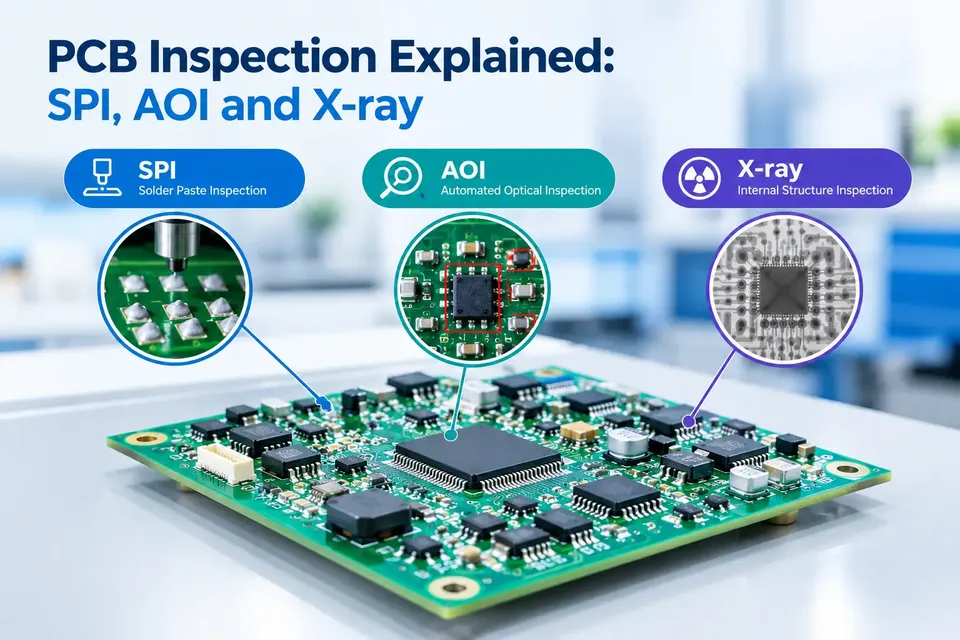
Automated inspection pays for itself here. SPI and AOI catch drift in the process before it produces a batch of defects. Dedicated test fixtures, such as in-circuit test beds of nails or custom functional test jigs, become worth the investment. Panelization is optimised to get the most boards out of every placement cycle.
How the main factors change with volume
Factor | Prototype | Low volume | High volume |
|---|---|---|---|
Main goal | Prove the design | Consistent, flexible supply | Lowest cost per unit, high yield |
Setup cost per board | High | Moderate | Negligible |
Testing | Bench / manual | Functional test, sometimes flying probe | Fixtures: ICT and functional jigs |
Engineering changes | Frequent | Occasional | Rare, tightly controlled |
Component buying | Small lots, distributor stock | Buffer stock for critical parts | Contracted supply, forecasts |
Planning the jump to production
The move from prototype to volume is where projects stall, usually for one of three reasons: a part that was fine to buy in tens is on allocation in thousands, a DFM issue that was tolerable by hand becomes a yield problem on the line, or nobody planned a production test.
Three things help:
- Freeze the BOM with approved alternates before ordering production parts.
- Run a pilot batch on the production line and review yield and AOI data before scaling up.
- Agree the test strategy and fixtures while the pilot is running, not after.
From prototype to production
Polyfit's EMS division handles rapid prototyping through to full-scale production, for both low- and high-volume runs, on a fully automated SMT line. Talk to us about your build.
From precision components to custom manufacturing, Polyfit delivers solutions tailored to your application and specifications.
Request a quote